
the-best-virtual-staging-ai-tools-for-real-estate-agents-a-2026-review-AyOn
An empty property listing is a missed opportunity. Potential buyers struggle to envision a home in a vacant space, and stark, unfurnished rooms often appear smaller and less appealing online. While physical staging costs thousands of dollars and presents significant logistical challenges, the alternative has been a slow and sometimes unreliable process. For Australian agents seeking a competitive edge, the rapid evolution of virtual staging AI offers a powerful, prompt, and professional solution to this persistent marketing problem.
But with a growing number of platforms, how do you identify a tool that delivers high-standard, realistic results? This comprehensive 2026 review provides the clarity you need. We analyse the leading virtual staging AI tools available today, comparing their key features, image quality, and pricing in AUD. You will discover which platforms can help you secure a faster sale at a higher price and gain expert insight into when to leverage this technology versus when engaging a professional remains the superior choice for a flawless result.
In today's competitive Australian real estate market, presenting a property in its best light is non-negotiable. Virtual Staging AI is a cutting-edge technology that uses generative artificial intelligence to digitally furnish and style photographs of empty rooms. This process transforms vacant, uninspiring spaces into vibrant, fully-furnished homes that capture buyer imagination. The core objective mirrors that of traditional home staging-to showcase a property's true potential-but it achieves this with unparalleled speed, cost-effectiveness, and flexibility, providing a powerful tool for modern real estate agents.
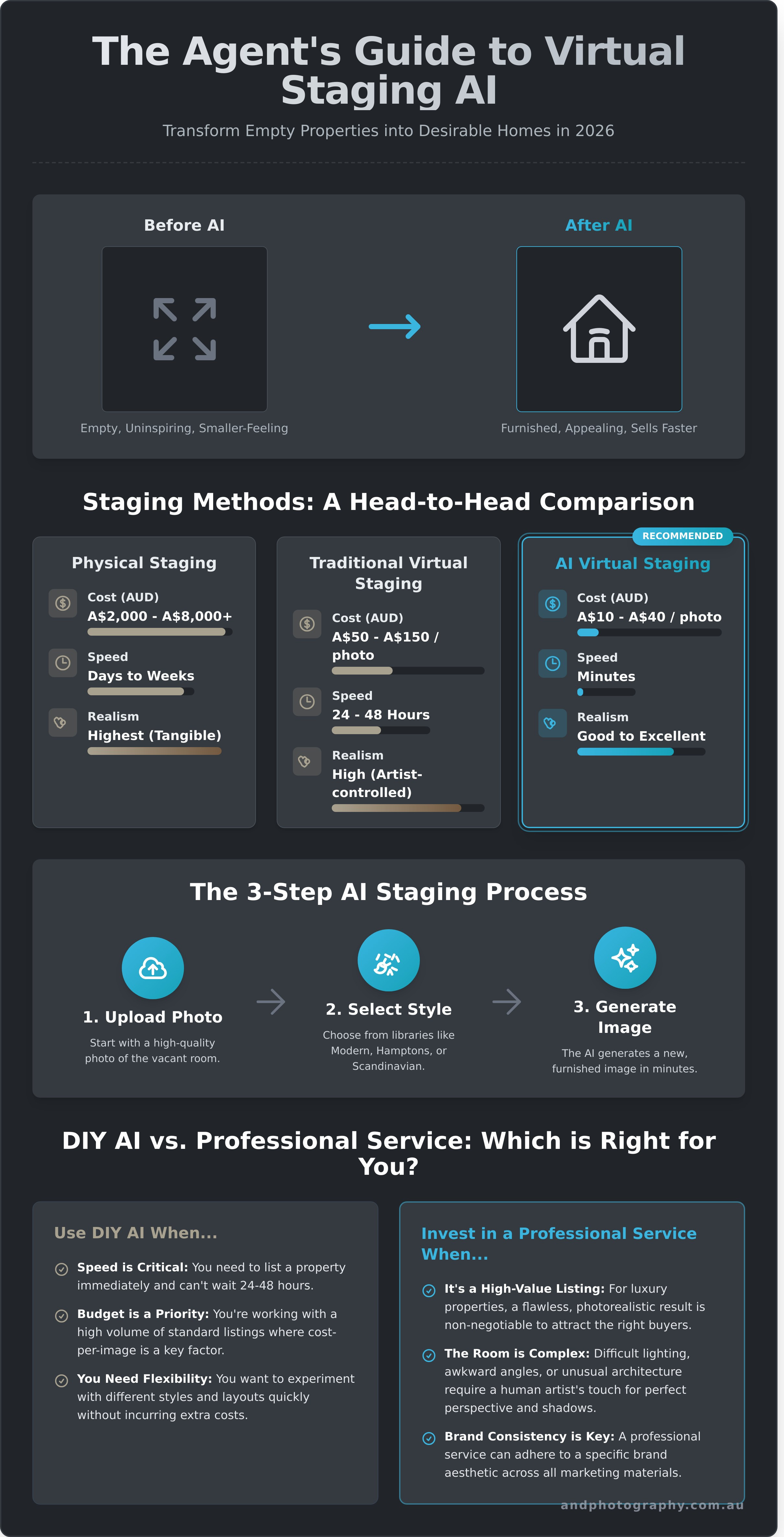
Understanding the key differences helps in choosing the right solution for your listing. Each method offers distinct advantages in cost, speed, and final result.
| Feature | Physical Staging | Traditional Virtual Staging | AI Virtual Staging |
|---|---|---|---|
| Cost (AUD) | High (A$2,000 - A$8,000+) | Medium (A$50 - A$150 / photo) | Lowest (A$10 - A$40 / photo) |
| Speed | Slow (Days to weeks) | Medium (24 - 48 hours) | Fastest (Minutes) |
| Realism | Highest (Tangible) | High (Artist-controlled) | Good to Excellent (Varies by tool) |
| Customisation | Limited by inventory | High (Designer's skill) | High (Style libraries) |
The technology behind virtual staging ai is a form of generative AI, an algorithm trained on vast libraries of interior design images, furniture, and architectural styles. For an agent, the process is remarkably straightforward and efficient:
The quality, realism, and stylistic accuracy of the final image depend heavily on the sophistication of the specific AI tool used. This is why different platforms produce different results, making it crucial to select the right service to elevate your property listings.
Selecting the right virtual staging ai tool is crucial for achieving professional, high-quality results that attract buyers. To help you choose wisely, we have prepared an objective review of the top three platforms making an impact in the Australian market. Industry leaders are also highlighting what agents should look for, as discussed in this insightful article from the National Association of REALTORS® on AI staging, which covers benefits and ethical considerations. Below, we assess each platform on its key features, pricing model, and ideal use case to streamline your decision-making process.
This platform is engineered for maximum efficiency, allowing agents to transform empty rooms with a single click. Its intuitive interface provides a selection of popular design styles and includes a powerful item removal feature to declutter existing spaces before adding new furniture. The subscription model, based on credits that do not expire, offers excellent flexibility for fluctuating business needs.
For agents focused on cost-efficiency, this tool presents a compelling solution. It delivers instant results and supports multi-view staging, all for a low monthly fee that typically covers a generous number of images. The interface is straightforward, ensuring a minimal learning curve for new users. While it delivers reliable results, its furniture and decor library is more limited compared to premium competitors.
When meticulous detail and photorealistic quality are non-negotiable, ApplyDesign.io stands out. It offers a comprehensive suite of tools, including advanced AI decluttering and an extensive catalogue of high-end furniture. This platform gives users a high degree of control to fine-tune every element in a scene. The per-image pricing, with discounts for bulk purchases, suits professionals who require premium quality for key listings.
Selecting the right virtual staging AI tool requires a professional evaluation of its core capabilities, not just its brand name. To make an informed decision that delivers a high standard of quality for your listings, focus on the criteria that directly impact the final result. This approach allows you to justify your investment and understand the precise capabilities-and limitations-of your chosen platform.
The single most important factor is the final image quality. A superior tool produces results that are indistinguishable from traditional staging. Scrutinise the realism of lighting, the accuracy of shadows, and the textures of furniture and decor. A common pitfall is the 'uncanny valley' effect, where an image looks almost real but something is slightly off, which can deter potential buyers. Always review the platform’s public gallery to assess the quality of their output before committing.
Your chosen tool must align with your target market's aesthetic. For the Brisbane market, this means having access to relevant styles like Hamptons, Coastal, and Contemporary Modern. Evaluate the breadth and quality of the virtual furniture catalogue-is it extensive and regularly updated with current trends? A key professional feature is the ability to save preferred styles or furniture sets, ensuring consistent branding across all your property listings and creating a signature look for your agency. For agencies that want to develop this signature look into a comprehensive brand identity, you can learn more about Pro-Creative and the benefits of working with a full-service creative partner.
An effective tool should enhance your workflow, not complicate it. Look for a streamlined interface that allows for simple 'upload-and-click' functionality. Beyond basic staging, assess the power of its advanced features. High-quality AI item removal and decluttering can save significant time and money on vacant possession properties. Furthermore, some platforms offer virtual renovation tools, such as changing floor colours or wall paint, which provide immense value. These advanced capabilities are a core part of how AI is changing real estate marketing, moving beyond simple furniture placement to genuine property enhancement.
Of course, a seamless workflow also depends on reliable technology. When your computer systems are slow or malfunctioning, it can bring productivity to a halt, preventing you from using these powerful tools effectively. For agents who need professional IT support to keep their business running smoothly, you can discover Aspire Computing and their services for small businesses.
While the speed of a DIY virtual staging platform is tempting, the risks to your professional reputation can be significant. A poorly executed virtual stage does more than just look unprofessional-it can actively deter potential buyers by creating a sense of distrust. The line between enhancing a space and misrepresenting it is fine, and automated tools often cross it without a professional's guidance.
Of course, visual pitfalls are only one part of the equation. Before any staging, virtual or physical, it's essential to ensure the property itself is presented in the best possible condition. Unaddressed issues like pest infestations can instantly turn off buyers during a viewing, regardless of how appealing the online photos are. For agents in NSW, ensuring a property is free from common pests like spiders is a critical first step, and services from professionals like ABC Pest Control Sydney can be invaluable in preparing a home for the market.
A machine can place a sofa, but it cannot create a compelling design narrative that resonates with buyers. AI lacks an understanding of taste, flow, and aspirational living. This frequently results in rooms with clashing furniture styles, poor colour schemes, and awkward layouts that hinder a room's perceived flow. A professional ensures the staging complements the home's unique architecture, whether it's a modern Brisbane apartment or a classic Queenslander, creating a cohesive and desirable vision. This is where the expertise of a professional design agency becomes invaluable; for instance, teams like DesignEdge specialize in creating the visual assets that build a compelling brand narrative.
The most immediate giveaway of low-quality virtual staging ai is technical error. Even minor flaws can make a potential buyer question the integrity of the entire listing. These small details erode trust and signal a lack of professionalism. Common issues include:
These errors are often compounded when the initial photograph isn't of a high professional standard, making a realistic result impossible.
Beyond the visual pitfalls, the increasing reliance on digital tools and online platforms introduces broader business risks. For any real estate agency handling sensitive client and financial data, robust digital protection is not just an option—it's a necessity. To safeguard your business operations, it's crucial to explore Cyber security measures and best practices.
To maintain credibility and adhere to professional standards in Queensland, it is essential to always disclose when an image has been virtually staged. Transparency is key to building and maintaining trust with buyers. Clearly labelling images as "Virtually Staged" or "Artist's Impression" is not just good practice; it's a hallmark of a reputable agent. This simple act protects your brand and ensures you are marketing the property ethically and effectively.
The emergence of powerful virtual staging ai platforms gives agents a critical choice: take a hands-on DIY approach or partner with a professional service. The right decision depends entirely on the property, your timeline, and the standard of quality your brand represents. This framework will help you determine the most effective path for your listing.
A DIY virtual staging tool can be a practical asset in specific situations. This approach is often best suited for:
For the majority of sales campaigns, especially in a competitive market, engaging a professional delivers a clear return on investment. This is the required approach for:
This focus on core revenue-generating tasks is a principle shared by successful agencies worldwide. For more articles and professional insights on real estate marketing and client services, you can check out ZHReality – Ing. Zdeněk Hašek.
Ultimately, even the most advanced AI is only as good as the source image it works with. A poorly lit, low-resolution photo will always produce a subpar result. The best outcomes begin with a perfect foundation: high-resolution, expertly composed, and professionally lit photographs. By engaging an expert to manage the entire process, you guarantee a seamless workflow from the initial photoshoot to the final, beautifully staged images that capture buyer attention. Ensure your listings stand out with our professional photography and staging services.
As we've explored, the landscape of real estate marketing is rapidly changing. While the rise of virtual staging ai offers agents powerful and accessible tools, it is not a one-size-fits-all solution. The key takeaway is that while these platforms provide a fast and often low-cost option, they carry the significant risk of unrealistic renders, poor lighting, and a lack of professional polish that can ultimately detract from a premium listing's appeal. Understanding when to use a DIY tool versus when to engage a professional is crucial for protecting your brand and maximising your sale price.
For Brisbane agents who demand consistently high-quality, professional results, partnering with an expert remains the most reliable strategy. At AND Photography, we leverage our deep expertise in both photography and property marketing to create compelling, realistic, and market-ready images. Trusted by Brisbane's leading real estate agencies, we deliver visuals that capture attention and drive buyer interest. Contact us today to discuss professional photography and virtual staging for your Brisbane listings.
By investing in quality presentation, you ensure your properties stand out in a competitive market and achieve the premium results they deserve.
Yes, it is essential to disclose the use of virtual staging in Australia. Under Australian Consumer Law, agents must not engage in misleading or deceptive conduct. Failing to disclose that an image has been digitally altered could be seen as misrepresenting the property. Always include a clear disclaimer, such as "Digitally furnished for illustrative purposes," on all virtually staged images to maintain transparency and comply with professional standards set by state real estate institutes.
The cost difference is substantial. Professional physical staging in Australia typically costs between A$2,500 and A$8,000+ for a standard home marketing campaign. In contrast, virtual staging AI services usually charge on a per-photo basis, with prices ranging from approximately A$20 to A$60 per image. This makes it a highly cost-effective solution for presenting a property in its best light, allowing you to stage an entire home for a fraction of the physical cost.
Yes, a key feature of most advanced virtual staging AI platforms is the ability to digitally remove existing furniture and clutter from your photos. This process, often called 'virtual clearing' or 'item removal,' creates a clean, empty canvas. Once the room is cleared, the software can then add new, stylish digital furniture and decor. This is particularly useful for tenanted properties or homes with dated furnishings that may not appeal to a broad market.
For the most professional and realistic results, high-resolution photos taken with a wide-angle lens are ideal. Ensure the room is well-lit with natural light where possible, and capture images from a corner to show the room's scale and layout effectively. While AI can work with various qualities, starting with crisp, professionally captured images provides the best foundation for the software to accurately place furniture, calculate perspective, and render shadows for a high-standard, believable result.
When done professionally and disclosed correctly, virtual staging is a powerful marketing tool that attracts, rather than deters, buyers. It helps potential buyers visualise a vacant property as a home and understand the scale and potential of each room. The key is transparency; as long as a clear disclaimer is used and the staging is tasteful and realistic, buyers appreciate the effort to showcase the property's possibilities. It is far more effective than presenting empty, uninspiring rooms.
While you can use photos from a modern smartphone, professional photography is strongly recommended for a high-quality outcome. Phone images can often lack the resolution, lighting quality, and wide-angle perspective needed for the AI to produce a seamless and realistic result. For a polished, professional marketing campaign that reflects a high standard of quality, investing in professional real estate photography provides the optimal base for any virtual staging application, ensuring your listing stands out.